
Running
What Your 10K Says About Your Marathon
Published on August 13, 2026
Type a 10 km time into any race predictor and it hands back a marathon time to the second. The precision is real, the confidence is not. Here is what the calculation actually does, why two models built decades apart land within half a minute of each other, and the one assumption underneath both that can move your marathon prediction by more than half an hour.
VDOT, backwards
A race result gives you a VDOT, a single number describing the engine that produced it. Prediction reverses the question: given that engine, what time would it produce over some other distance?
There is no clean way to rearrange the equations for this, because the fraction of maximum you can sustain depends on how long the race takes, and how long it takes is what you are trying to find. So the answer gets searched for rather than solved. Guess a time, compute the VDOT it implies, compare against the VDOT you have, adjust, repeat. Since a slower time always implies a lower VDOT, the search converges on one answer, and sixty rounds of halving the interval pin it to well under a second.
Run that across a range and you get the table every predictor is really printing:
| VDOT | 5 km | 10 km | Half | Marathon |
|---|---|---|---|---|
| 35 | 26:59 | 56:02 | 2:04:13 | 4:16:06 |
| 40 | 24:06 | 50:01 | 1:50:54 | 3:49:37 |
| 45 | 21:49 | 45:13 | 1:40:14 | 3:28:16 |
| 50 | 19:56 | 41:20 | 1:31:31 | 3:10:40 |
| 55 | 18:22 | 38:06 | 1:24:16 | 2:55:55 |
| 60 | 17:03 | 35:22 | 1:18:09 | 2:43:22 |
Daniels against Riegel
There is an older and much simpler approach. Pete Riegel's formula scales a known time by the ratio of distances raised to a power:
T2 = T1 * (D2 / D1) ^ 1.06That exponent above 1 is doing all the work. It says a race twice as long takes slightly more than twice as long, because you cannot hold the same pace. Riegel fitted 1.06 to race results in the 1970s. Daniels' approach came from oxygen cost curves and has nothing structurally in common with it.
Give them both the same 10 km in 50:00:
| Distance | Daniels | Riegel | Gap |
|---|---|---|---|
| 5 km | 24:06 | 23:59 | 7 s |
| Half | 1:50:52 | 1:50:19 | 33 s |
| Marathon | 3:49:34 | 3:50:01 | 27 s |
Twenty-seven seconds apart over nearly four hours, from two methods that share no maths. That agreement is worth something. It means the shape of the fatigue curve is not in dispute, and neither model is an outlier you should worry about.
The endurance assumption
Both answer the same narrow question: how fast would a runner equally trained for every distance cover this one? Nobody is equally trained for every distance. A 10 km time reflects a fitness you have demonstrated over 50 minutes, and a marathon asks you to keep going for four hours on legs that may never have gone past two.
In Riegel's formula that assumption lives entirely in the exponent, which makes it easy to see what it is worth. Keep the same 10 km and vary only that number:
| Exponent | Describes | Marathon |
|---|---|---|
| 1.06 | High mileage, marathon specific | 3:50:01 |
| 1.08 | Solid endurance base | 3:56:44 |
| 1.10 | Moderate weekly volume | 4:03:39 |
| 1.12 | Speed ahead of endurance | 4:10:46 |
| 1.15 | First marathon off short training | 4:21:50 |
Thirty-two minutes between the top and bottom row, from one identical 10 km. Every predictor you have used quietly picked the top row for you. That is why the number it returns should be read as a ceiling: the time you would run if your endurance matched your speed, which is a claim about your training history and not about your 10 km.
A second opinion
The useful move is to feed the predictor more than one race. Predict the marathon from your 5 km, then from your half, and compare.
- The two agree. Your speed and endurance are in proportion. The prediction is as trustworthy as it gets.
- The 5 km predicts faster. Speed is ahead of endurance. Trust the longer race and add long runs before you trust the shorter one.
- The half predicts faster. Unusual, and normally means the shorter race was run below your ability rather than that you are secretly an endurance monster.
The half marathon is the most honest input for a marathon prediction, because it is long enough that fuelling, pacing discipline and legs that have been running for over an hour all get a say.

In the app
A predicted time is only useful if it does something. Two things it should do: set the pace you rehearse in training, and set what the weeks between now and the race look like.
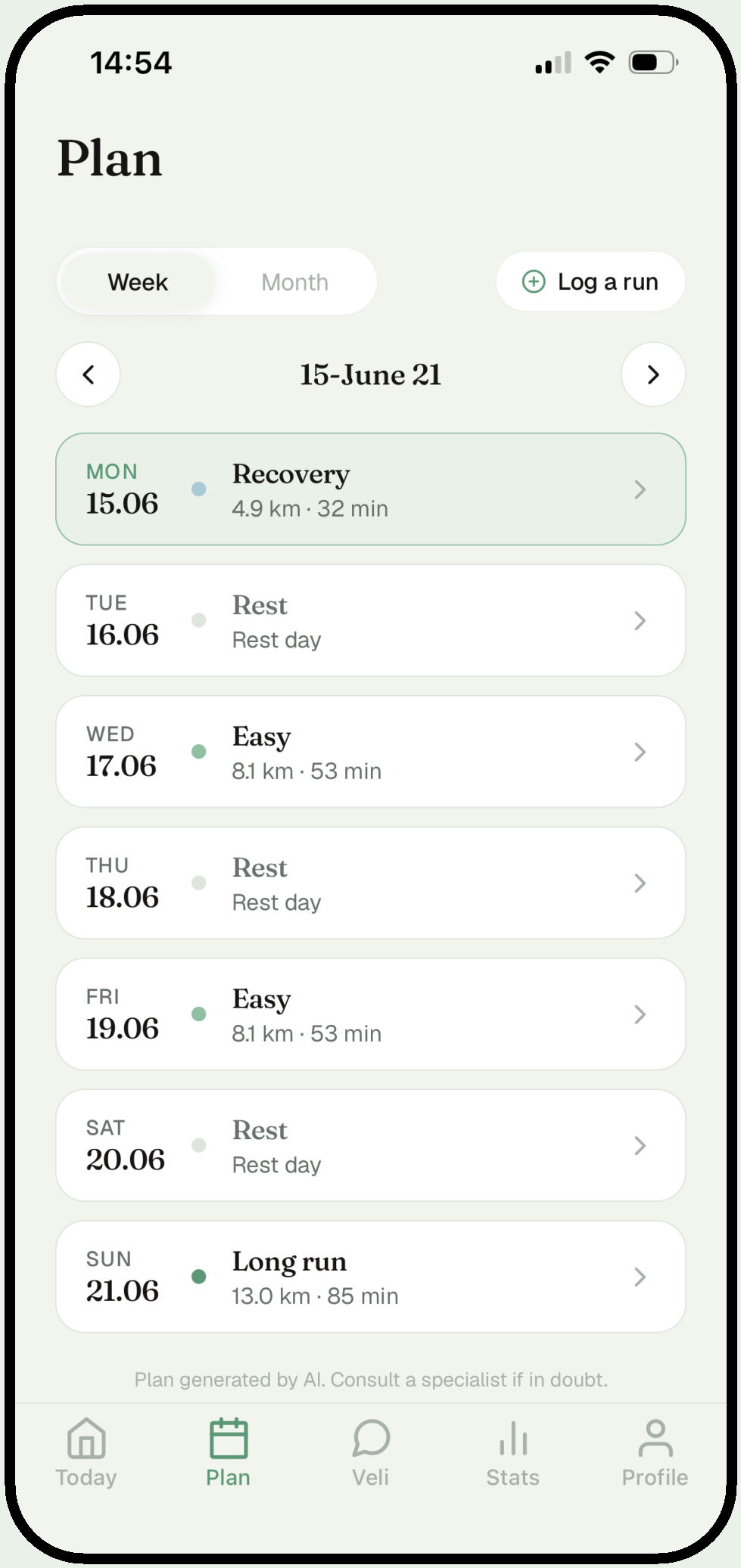
Velapp runs the same search described above against your current VDOT, then builds the plan backwards from the race date rather than handing you a number and wishing you luck. When a run beats your previous best, the prediction moves and so do the sessions after it. The weekly volume rise stays capped whatever the prediction says, because the fastest way to miss a goal race is to train for the version of yourself the calculator described.
In short
A race predictor tells you what your engine is capable of over a distance you have not raced. It does not know whether you have built the endurance to use it. Treat the number as the best case, take a second reading from a longer race, and spend the gap between them on long runs rather than on arguing with the calculator.
Try it yourself
If you want the training block that follows from the prediction rather than just the number, Velapp builds one backwards from your race date off a single recent time.

Keep reading
Product
What Veli Actually Knows About Your Training
An AI coach is only worth the context it has. What Veli reads before answering, and a real question answered from a plan built minutes earlier.
Product
How Velapp Builds Your Week
What decides each session, why the first week is short, and the easy pace that matched Daniels' table without being told to.