
Running
VDOT: One Race Time, Every Training Pace
Published on August 13, 2026
A race result carries more information than most runners take from it. VDOT is the standard way of extracting it: one number, derived from one performance, that sets every pace you should be training at. Here is the actual arithmetic, what it predicts well, and where it quietly misleads you.
What the number is
VDOT comes from Jack Daniels' Running Formula. It is usually described as "your VO2 max", which is close enough to be useful and wrong enough to matter.
A lab VO2 max is a physiological measurement: how much oxygen you consume at maximal effort, taken with a mask on a treadmill. VDOT answers a different question. Given the race you just ran, what VO2 max would a runner of textbook efficiency have needed in order to run it?
That is why two runners with identical lab values can have different VDOTs. Running economy, lactate threshold and your tolerance for discomfort all fold into a race time, and therefore into VDOT. For choosing training paces this is a feature. You want the number that reflects what you do on a road, not what you produce wearing a mask.
The formula
Two equations. The first estimates the oxygen cost of running at velocity v, in metres per minute:
VO2 = -4.6 + 0.182258 * v + 0.000104 * v^2The second estimates what fraction of your maximum you can hold for a duration t, in minutes:
%max = 0.8 + 0.1894393 * e^(-0.012778 * t) + 0.2989558 * e^(-0.1932605 * t)VDOT is the first divided by the second.
The second equation is the one worth sitting with. It encodes something every runner already knows in their legs: the longer you race, the smaller the fraction of your ceiling you can hold. Put durations through it and the curve is stark.
| Duration | Roughly | % of max |
|---|---|---|
| 5 min | 1500 m | 109.1% |
| 15 min | fast 5 km | 97.3% |
| 30 min | quick 10 km | 93.0% |
| 60 min | threshold reference | 88.8% |
| 90 min | half marathon | 86.0% |
| 200 min | marathon | 81.5% |
Two things fall out of that table. The gap between a 10 km and a marathon is about nine percentage points of your ceiling, which is why a marathon paced off 10 km effort ends badly and always has. And the top row exceeds 100%, which is not a bug. Below roughly ten minutes the anaerobic system contributes enough that oxygen consumption alone no longer explains the performance, so the formula reports a fraction above maximum. Treat anything under about 10 minutes as outside the model's comfortable range and use a longer race if you have one.
A 10K in 50:00
Take a 10 km in 50:00.
| Step | Calculation | Result |
|---|---|---|
| Velocity | 10000 m / 50 min | 200.0 m/min |
| Oxygen cost | -4.6 + 36.4516 + 4.16 | 36.01 ml/kg/min |
| Sustainable fraction | 0.8 + 0.10000 + 0.00002 | 0.900 |
| VDOT | 36.01 / 0.900 | 40.0 |
Look at the third row. The second exponential contributed 0.00002, which rounds away entirely at this duration. It only carries weight under about ten minutes, and that is precisely the region where the sustainable percentage shoots past 100% in the table above. The two facts are the same fact seen from different ends.
Setting your paces
Not comparison. The point of VDOT is that a single value calibrates your whole training range, because each intensity sits at a known fraction of it:
- Easy: builds aerobic base at almost no cost. Most of your weekly volume belongs here.
- Marathon: roughly what you could hold for the distance, used inside long runs.
- Threshold: about an hour of race effort, where lactate stops accumulating faster than you clear it. Comfortably hard, and the highest-return session for most runners.
- Interval: repeats of three to five minutes near VO2 max, aimed at the ceiling itself.
- Repetition: short and fast, for economy and mechanics rather than the aerobic system.
Get VDOT right and all five follow from it. Get it wrong and every session in your week is calibrated to a runner who is not you.
When it is wrong
The formula is sound. The way people feed it usually is not.
- One race, one day. Heat, a headwind, a stomach that turned on you at 6 km, or a first kilometre run 15 seconds too fast will all understate the result. A performance is evidence, not a verdict.
- A distance mismatch is information, not noise. If your 5 km gives VDOT 52 and your half marathon gives 46, nothing is broken. You are being told that you have speed and no endurance. Daniels' tables assume you are equally trained across distances, and almost nobody is. Train the gap instead of averaging it away.
- It goes stale. A VDOT from March is a fact about March. Eight consistent weeks move it, and so do eight weeks off.
- It says nothing about durability. Two runners at VDOT 50 can absorb very different weekly loads. VDOT sets your paces and has no opinion on how much volume you can take, which is the variable that actually breaks people.
Easy days are not easy
Easy days get run too fast. The easy pace that falls out of a VDOT table tends to feel insultingly slow, so it gets nudged up by 20 or 30 seconds per kilometre, which quietly converts an easy day into a mediocre moderate one. Do that four times a week and the hard sessions have nothing left to work with.
If your easy pace feels barely worth leaving the house for, there is a decent chance you have it right.
Keeping it current
The maintenance problem is the real one. Your VDOT moves, every pace derived from it moves with it, and recalculating five training zones by hand after each good race is the kind of chore people abandon by week three.
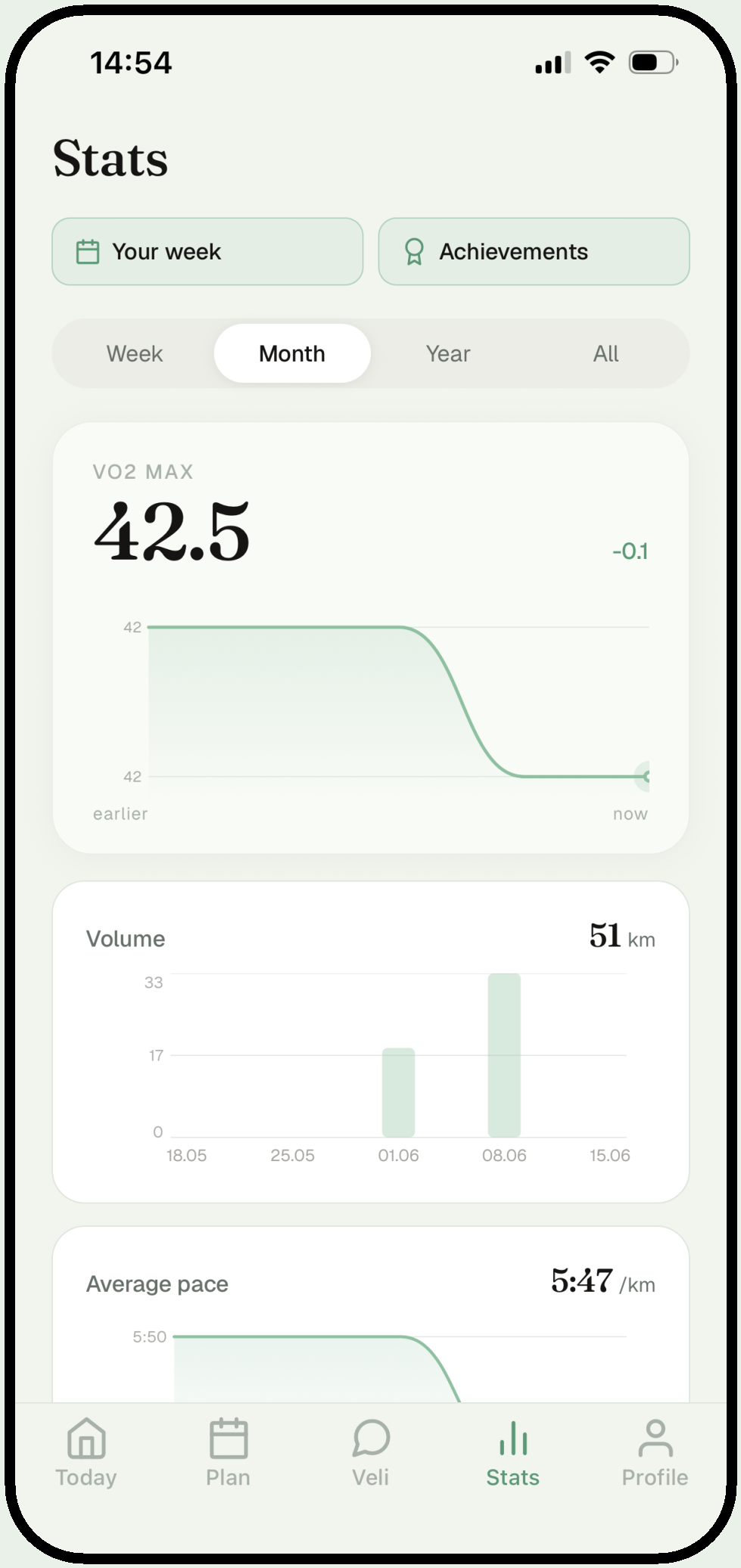
That is the part Velapp automates. It computes VDOT from your best recent performances using the formulas above, tracks how it moves, and re-derives every training pace and heart-rate zone as soon as a run beats your previous best. Next week gets built from the number you have now rather than the one you had when you installed the app.
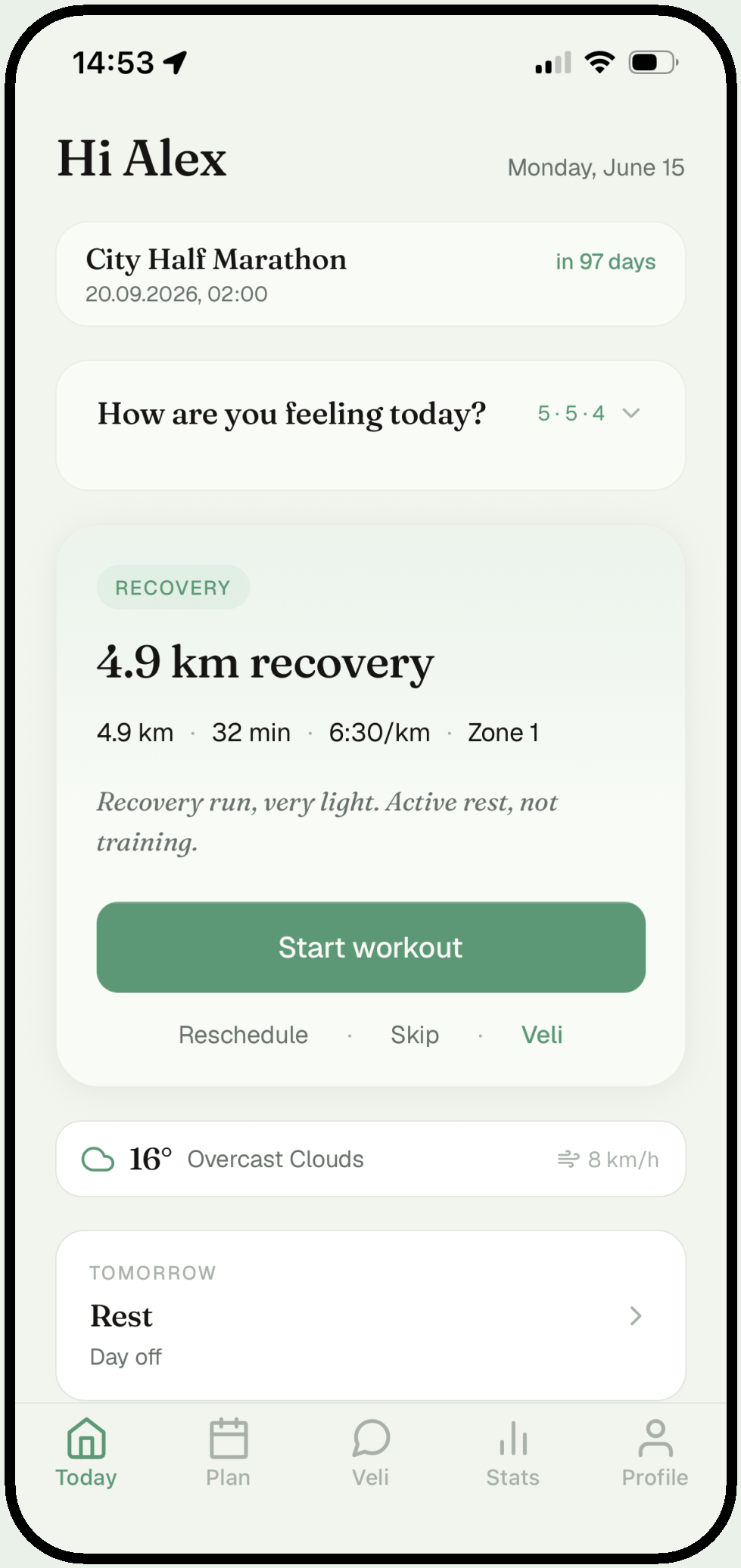
The safety rail matters as much as the arithmetic. A rising VDOT tempts you to add volume at the same moment, and that combination is where most training blocks come apart. Weekly increases stay capped no matter how good the number looks.
In short
VDOT is a translation layer. It converts something you did into something you should do. It is only as good as the performance you feed it, and only current for as long as your fitness stands still, which is not long in either direction.
Try it yourself
Velapp does the translation on every run, so your paces and zones follow your VDOT instead of waiting for you to redo the table lookups.

Keep reading
Product
What Veli Actually Knows About Your Training
An AI coach is only worth the context it has. What Veli reads before answering, and a real question answered from a plan built minutes earlier.
Product
How Velapp Builds Your Week
What decides each session, why the first week is short, and the easy pace that matched Daniels' table without being told to.