
Running
Heart Rate Zones: Beyond 220 Minus Age
Published on August 13, 2026
Heart rate zones are simple arithmetic, which is exactly why so many runners end up in the wrong one. There are two places the maths goes wrong. The first is well known and matters less than people think. The second is bigger, quieter, and can put you seventeen beats away from where you meant to be.
Your maximum, estimated
Every zone is a fraction of your maximum heart rate, so an error there propagates into all five. The formula almost everyone uses is 220 - age, published by Fox in 1971 and never intended as a precise tool. A better fit came from Tanaka in 2001: 208 - 0.7 x age.
They disagree in an interesting way.
| Age | 220 - age | Tanaka | Difference |
|---|---|---|---|
| 20 | 200 | 194 | -6 |
| 30 | 190 | 187 | -3 |
| 40 | 180 | 180 | 0 |
| 50 | 170 | 173 | +3 |
| 60 | 160 | 166 | +6 |
| 70 | 150 | 159 | +9 |
The two agree exactly at 40 and diverge in both directions from there. Young runners get a maximum that is too high, which pushes every zone up and makes easy days harder than intended. Older runners get the worse deal: at 70 the old formula hands you a ceiling nine beats below a more realistic estimate, and nine beats is enough to relabel a genuinely aerobic run as threshold work you never meant to do.
Both are population averages, and the spread around them is wide. Two people of the same age can differ by more than ten beats with nothing wrong with either. A formula gives you a defensible starting point, not a measurement. If you have ever seen a higher heart rate in a hard race than your formula allows, believe the race.
Percent of what?
Now the part that gets skipped. A zone written as "70%" is ambiguous, and the two readings are not close.
The naive reading takes 70% of your maximum. The Karvonen method takes 70% of your heart rate reserve, which is the span between resting and maximum, then adds resting back on. Reserve is the range you actually have available to work in. At rest your heart is not doing zero work, so treating raw maximum as the scale starts the ruler in the wrong place.
Take a 55-year-old with a resting heart rate of 55. Tanaka puts maximum at 170, so reserve is 115.
| Reading of "70%" | Calculation | Target |
|---|---|---|
| Of maximum | 0.7 x 170 | 119 bpm |
| Of reserve | 55 + 0.7 x 115 | 136 bpm |
Seventeen beats. For most runners that is the difference between a steady aerobic effort and a walk. Someone following the first number and wondering why their easy runs feel like nothing is not lacking discipline, they are using the wrong ruler. The gap grows the lower your resting heart rate goes, so the fitter you get, the more the naive version misleads you.
Five zones, one runner
Same runner, all five zones by reserve, with what each range works out to as a percentage of raw maximum so you can see how far apart the two framings sit.
| Zone | Beats | % of reserve | % of maximum |
|---|---|---|---|
| 1 Recovery | 113 - 124 | 50 - 60% | 66 - 73% |
| 2 Easy | 124 - 136 | 60 - 70% | 73 - 80% |
| 3 Aerobic | 136 - 147 | 70 - 80% | 80 - 86% |
| 4 Threshold | 147 - 159 | 80 - 90% | 86 - 94% |
| 5 VO2 max | 159 - 170 | 90 - 100% | 94 - 100% |
Read the last two columns together and the confusion resolves itself. Zone 2 by reserve lands at 73 to 80% of maximum, which is why advice phrased as "keep easy runs under 80% of max" and advice phrased as "zone 2" can both be right while sounding contradictory.
What each zone does
- Recovery: circulation without load, for the day after something hard. If it feels like training, it is not recovery.
- Easy: where the aerobic adaptations happen and where most of your week belongs. Conversational, and dull by design.
- Aerobic: steady work, the middle of a long run. Useful, and also the zone most people drift into when they meant to be easy.
- Threshold: lactate clearance keeping pace with production, roughly an hour of race effort. The highest-return session for most runners.
- VO2 max: repeats hard enough that you count minutes. Small doses, and only on a base that can absorb them.
Zones are one way to steer effort. Pace is another, and the two disagree often enough that it is worth knowing which to trust on a given day. Pace comes from your VDOT, which is stable. Heart rate responds to everything.
When the number lies
Before you conclude your zones are wrong, rule out the ordinary reasons the number moved:
- Heat. Same pace, same effort, ten beats higher, because circulation is also doing cooling work.
- Cardiac drift. On a long run heart rate climbs while pace holds. An hour in, the same effort reads higher, and chasing the number down means finishing slower than the session intended.
- Sleep, stress, caffeine, illness. All move resting and working heart rate, sometimes by a lot.
- The strap. Wrist optical sensors lose the plot in cold weather and during intervals. A jagged trace with impossible jumps is a measurement problem, not a physiology problem.
None of this is a reason to ignore heart rate. It is a reason to treat a single session as weak evidence and a pattern across weeks as strong evidence.
In the app
The arithmetic is not hard, it is just tedious and it goes stale. Resting heart rate falls as you get fitter, which changes reserve, which moves all five zone boundaries. Recalculating that by hand every few weeks is a chore nobody keeps up.
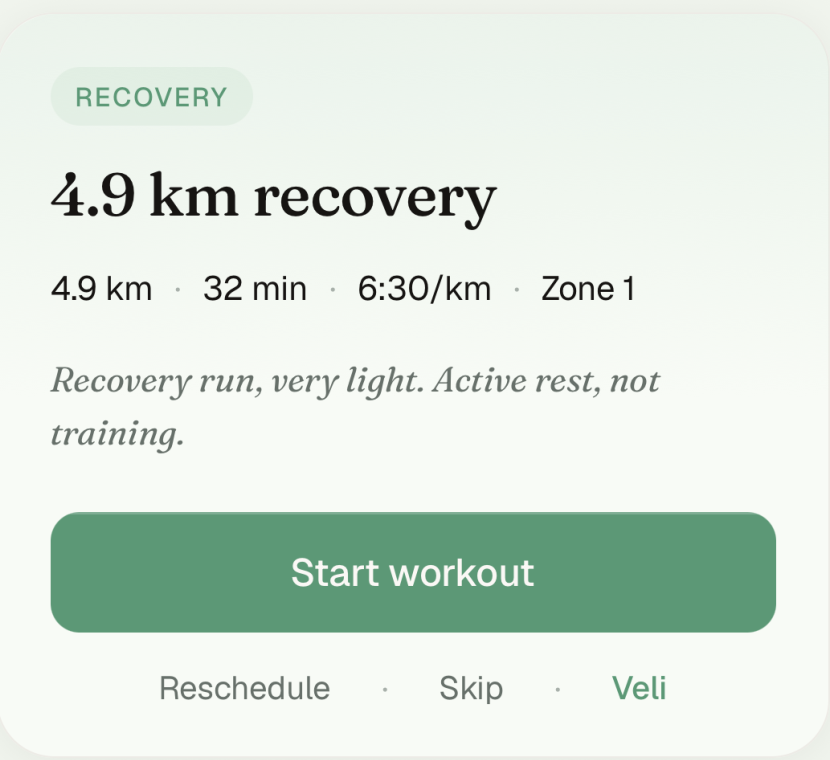
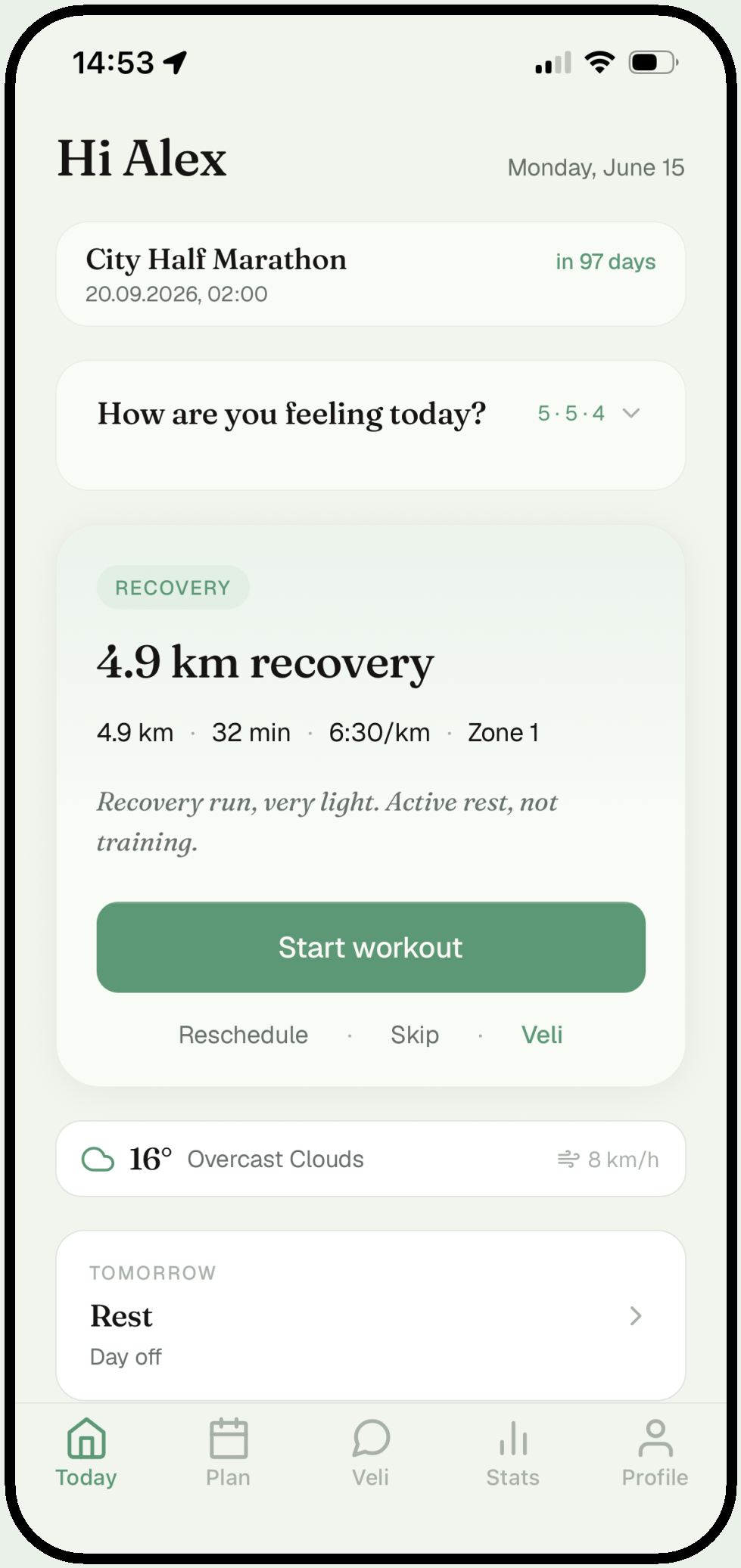
Velapp uses the Tanaka formula and the Karvonen reserve method, so the zones you get are the ones in the table above rather than the naive version. Each session arrives with both its target pace and its zone, and the zones move on their own as your resting heart rate does.
In short
Use a better maximum than 220 minus your age, especially if you are far from 40. Then make sure whatever you are calling "70%" is a percentage of your reserve and not of your maximum, because that single misreading is worth more beats than the formula argument ever was.
Try it yourself
Velapp keeps the reserve arithmetic current as your resting heart rate falls, so the zone on each session is the one from the table above rather than a boundary that went stale two months ago.

Keep reading
Product
What Veli Actually Knows About Your Training
An AI coach is only worth the context it has. What Veli reads before answering, and a real question answered from a plan built minutes earlier.
Product
How Velapp Builds Your Week
What decides each session, why the first week is short, and the easy pace that matched Daniels' table without being told to.