
Running
The 10% Rule Is a Ceiling, Not a Target
Published on August 13, 2026
Almost every runner has heard that weekly mileage should not rise by more than 10%. Almost nobody has multiplied it out. Do that and the rule falls apart on its own terms, which tells you something useful about what it is actually for.
Twelve weeks of ten percent
Start at a comfortable 40 km per week and add 10% every week, exactly as instructed.
| Week | Weekly volume | Against week 1 |
|---|---|---|
| 1 | 40 km | - |
| 4 | 53 km | +33% |
| 8 | 78 km | +95% |
| 10 | 94 km | +136% |
| 12 | 114 km | +185% |
Nearly triple, in a quarter of a year, while never once breaking the rule. Anyone who has trained for more than a season knows that is not how it goes, which means the rule was never meant to be read as an instruction to add 10% every week. It is a ceiling on any single jump, and the difference matters because most people hear it as permission.
Where the number came from
The 10% figure is a heuristic, not a finding. It circulated through coaching long before anyone tried to test it, and when researchers did the results were mixed: a Dutch trial that put novice runners on a graded 10% programme found no reduction in injuries against a more standard schedule. That is not a reason to discard it. It is a reason to understand what it is doing.
Connective tissue adapts more slowly than the cardiovascular system. Within a few weeks your aerobic fitness will happily support a workload your tendons have not caught up with, and that gap is where most running injuries live. The rule is a crude brake on that gap. Crude, because a fixed percentage means something different at 20 km a week than at 100 km, and because it is silent about the thing that most often actually hurts people.
What it ignores
- Intensity. Swapping an easy run for intervals at identical distance changes the load enormously, and the weekly total does not move at all.
- The long run creeping. Weekly volume can rise 10% while the long run rises 30%, because the rest of the week shrank. Single-session jumps deserve their own limit.
- What else is happening. Sleep, work stress and illness all change what you can absorb. A body under load elsewhere has less capacity for training load.
- Coming back. After two weeks off, 10% of nothing is nothing. Return running needs its own ramp, usually starting well below where you stopped.
Build, then cut back
Build for a few weeks, then cut back, then build again from the reduced level. The down week is when adaptation gets consolidated, and it stops the compounding from running away.
| Week | Volume | |
|---|---|---|
| 1 - 3 | 40 - 48 km | building |
| 4 | 53 km | cut back |
| 5 - 7 | 44 - 53 km | building |
| 8 | 59 km | cut back |
| 12 | 64 km | +60% over the block |
Same starting point, same 10% ceiling on any individual step, and twelve weeks later you are at 64 km rather than 114. That is a real increase, arrived at by a route your tendons can follow.
Base, build, peak, taper
A training block is not a single ramp. It has phases, and they get different proportions of the time available:
| Plan length | Base | Build | Peak | Taper |
|---|---|---|---|---|
| 16 weeks | 1 - 4 | 5 - 10 | 11 - 14 | 15 - 16 |
| 12 weeks | 1 - 3 | 4 - 7 | 8 - 10 | 11 - 12 |
| 8 weeks | none | 1 - 5 | 6 - 7 | 8 |
Notice what happens to the eight week plan. There is no base phase at all, because there is not enough time to have one. Short notice does not compress a training block evenly, it deletes the part that builds durability and keeps the part that sharpens what you already have. If you are starting from a thin base, that is worth knowing before you enter a race eight weeks out.
In the app
The reason to automate this is that the temptation to break it arrives exactly when breaking it is most attractive. You feel good, the last block went well, the predictor is showing a time you like, and adding a few more kilometres seems obviously correct.
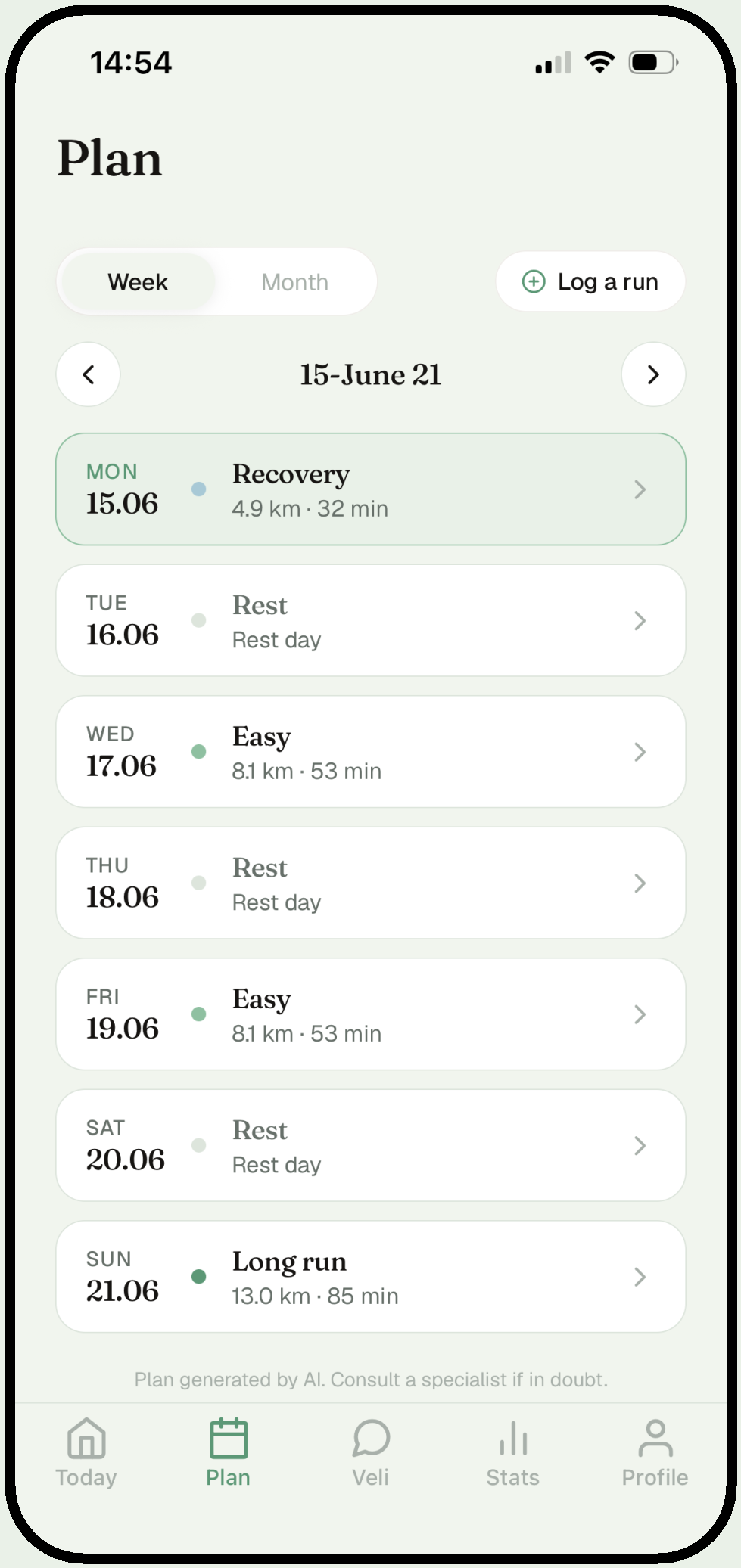
Velapp applies the ceiling to every week it generates, and it applies it after the plan has been rebuilt around your latest fitness rather than before. So a run that improves your numbers moves your paces immediately and your volume slowly, which is the correct order. The phases above come from the same engine, allocated from however many weeks remain until your race.
In short
Ten percent is a limit on any single step, not a schedule. Multiply it out weekly and it produces a number no coach would sign off on. Build in blocks with a cut-back week, give the long run its own limit, and remember the rule says nothing at all about how hard you ran.
Try it yourself
The ceiling, the cut-back weeks and the separate limit on the long run are all applied to the plans Velapp writes, so none of the arithmetic above has to live in a spreadsheet you maintain.

Keep reading
Product
What Veli Actually Knows About Your Training
An AI coach is only worth the context it has. What Veli reads before answering, and a real question answered from a plan built minutes earlier.
Product
How Velapp Builds Your Week
What decides each session, why the first week is short, and the easy pace that matched Daniels' table without being told to.